





Hello Falcons, and welcome back to the second edition of “The Falcon Flash!” Thank you all for tuning into the first edition and taking time out of your day to read some news. My goal with this column is to fill this gap by providing you with an objective and simplified breakdown of the biggest news story happening every week in the United States and across the world. No opinions, no complicated terms; just the knowledge you need to understand and think critically about our society.
It is SO exciting to watch so many students getting involved politically and exercising your rights of expression here at Staley. This week, we’re going to break down the most contentious topic of your news feeds: U.S. Immigration and Customs Enforcement, more popularly known as ICE. More specifically, this week’s column is going to objectively dive into the Jan. 7 shooting death of Renee Good, the history of ICE and how this story among others have become nationwide symbols of protest.
Renee Good
Of course, you’ve likely already seen snippets of this story on your feeds, but let’s take a step back and break down the facts of this story. A little more than two weeks ago, Good was shot and killed by an ICE officer in Minneapolis, Minnesota. Good was 37 and a mother of three. As shown by bystander footage, three ICE officers surrounded Good’s Honda Pilot before one demanded she open the door. Upon her attempts to drive away, she was shot at close range by the agent (AP News).
This case has drawn immediate virality and fiery debate on both sides. On one side, members of the current Trump administration and supporters of ICE argue the agent had to shoot as an act of self defense against the car “attempting to run them over,” a claim vehemently refuted by witnesses but supported by some officer perspectives (AP News). Vice president JD Vance blamed Good, stating that it was “a tragedy of her own making,” (AP News). Some even stated she was following ICE, another claim refuted by the lawyer for her family (New York Times). On the other side, many protesters are using this case to ask the deeper question of why an American citizen, born in Colorado and without any criminal history besides a traffic ticket, was even targeted by ICE in the first place.
What is ICE?
Answering this question requires us to zoom out a bit onto how ICE formed and what their job actually is (or at least, is supposed to be). While ICE has been growing in news prominence, it’s been around for a while; ICE was formed as a division under the Homeland Security Act passed in 2002 as a response to the Sept. 11, 2001, terror attacks (BBC).
The Federal Register, the “Daily Journal of the United States Government,” described ICE’s role as the “identification and elimination of border, economic, transportation and infrastructure security vulnerabilities.” Yet, despite their lengthy (and notably vague) job description, their most notable duty since founding has been deportations.
Deportations, defined by Cornell law school as “the formal removal of a person, typically a foreign national, from a country’s territory,” have become a pressing political issue in recent elections. In Trump’s 2024 election campaign, he controversially promised voters that under his “America First” philosophy, he would deliver the “largest deportation in U.S. history” (Oregon Public Broadcasting). However, despite the backlash his devotion to deportations has incurred, it’s important to note that he’s not the first president to deport. As Syracuse University found, the Obama administration deported more than 3.1 million people through ICE during his eight years in office. And, as the Migration Policy Institute reported, the Biden administration was responsible for 1.1 million deportations between January 2021 and February 2024.
So, if Obama and Biden also did deportations, why have the ICE actions under Trump garnered so much backlash? Ultimately, the differences lie not as much in the number of deportations, but rather in the reasoning behind who they target and the tactics they use.
Despite Obama and Biden’s collective ICE actions, they were generally accepted by the public to be beneficial because of their vocal commitment to targeting undocumented people who were criminals. The Law Enforcement Immigration Task Force described the difference between their ICE approaches, saying, “The Obama administration created immigration enforcement priorities to channel limited resources towards individuals it deemed to be high priorities, including threats to national security, threats to public safety and recent illegal entrants. Departing from this approach, the Trump administration sought to consider all undocumented immigrants high priorities for removal.”
This differing philosophy has rung true in the devastating instances like Renee Good’s; where despite Trump’s initial claims that he would focus on deporting criminals, virtually anyone (including children) is now a target (AP News). To put it simply, ICE under Trump has objectively gone a new direction, one with a dangerous combination of fewer regulations and higher quotas.
Protests
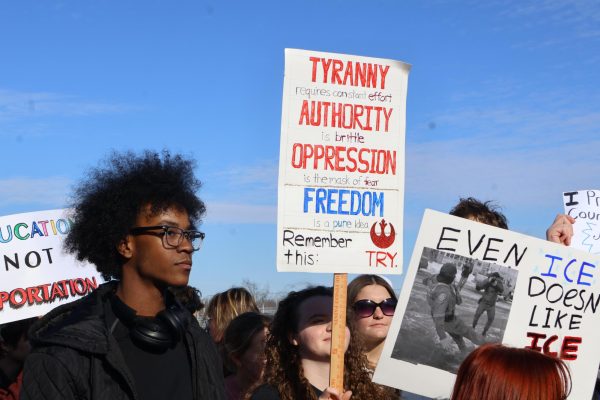
ICE has become one of the most polarizing topics in modern history, with people either loving or absolutely hating them. Nationwide, and as recently as Monday here at Staley with the walkout featuring anti-ICE signs, the stories of Renee Good and the 31 people killed by ICE in 2025 (a two-decade record high) were brought to the forefront. On signs and in speeches, they were symbols of rebellion against these agents and their increased targeting and tactics against children and citizens.
No matter how you feel, it’s clear that this political issue reaches beyond simply our feeds and headlines and is leaving very real impacts on the people around us. In these times, I urge everyone to know their rights (NAACP), show up for those affected and, as always, stay educated. Thanks for reading, and I can’t wait to see you back here for next week’s news in a flash.
Did you participate in the Staley walkout against ICE?
Sorry, there was an error loading this poll.

serena loving • Jan 25, 2026 at 10:17 AM
Very well-written, factual column. Very proud of you and your ability to deliver the information in a fair and straightforward way!